
The Zambia Agribusiness and Trade Project II (ZATP II) is a joint initiative of the Government of Zambia (GRZ) under the Ministry of Commerce, Trade and Industry (MCTI) and the World Bank Group aimed to contribute to increased access to markets, finance and promote agribusiness firm growth in Zambia. With a duration of five (5) years (2024-2028), ZATP II is a scale up project aimed to build on the successes of the Zambia Agribusiness and Trade Project (ZATP Project) implemented from 2017 to 2024 by GRZ through the MCTI with support from the World Bank Group. While ZATP covered 5 provinces (Central, Copperbelt, Eastern, Lusaka and Southern), ZATP II’s coverage is national in all the ten (10) provinces of Zambia. With a total budget of US$170.00 Million, the Project is anchored on three mutually reinforcing Components:1) Support access to markets and finance; 2) Promote Trade and Agribusiness Competitiveness; and 3) Project Management.
To contribute to increased access to markets and finance and promote firm growth in Zambia’s Agribusiness Sector
World Bank Group and Government of the Republic of Zambia
US$170 Million
Ministry of Commerce, Trade and Industry
2024-2028
133,500
National (All the 10 Provinces of Zambia)
1. Support access to markets and finance subcomponents
(a) MarketConnect
(b) Productive Alliances
(c) Line of Credit
2. Promote Trade and Agribusiness Firm Competitiveness
3. Project Management
The Ministry of Commerce, Trade and Industry (MCTI) is responsible for the overall coordination and implementation of the ZATP II through the Department of Planning and Information (DPI). MCTI is also responsible for administrative issues and policy decisions related to the ZATP II. The Permanent Secretary, Technical Investment is the Controlling Officer.The MCTI hosts ZATP II’s Project Implementation Unit (PIU) under the Department of Planning and Information.ZATP II has a two-tier governance structure comprising of a Technical Working Group (TWG) and the Project Steering Committee (PSC) supported by the PIU as the Secretariat. ZATP II has set up Provincial Productive Alliance Coordinating Committees to support to Producer Organisations (POs) and agribusiness firms. The structure further includes Investment Committee Panel (ICP), Proposal Evaluation Panel (PEP) and an Independent Evaluation Panel (IEP) to support the implementation of Component 1 on supporting access to markets and finance.
The TWG is mandated to monitor project progress and facilitate information sharing between key institutional stakeholders involved in the Project. Among other functions, the TWG is responsible for:
a.) Reviewing project annual work-plans and budgets;
b.) Reviewing project procurement plans;
c.) Reviewing quarterly implementation, monitoring and evaluation reports;
d.) Reviewing communication strategies and programs;
e.) Reviewing the performance of all committees under the project;
f.) Reviewing periodic financial reports; and
g.) All other technical issues relating to project components implementation.
The Second Technical Working Group (TWG) Meeting for ZATP II met on the 21st November, 2024 to review the 2025 Plan Annual Workplan and Budget. The meeting was Chaired by Director of Planning and Information, Mr. Edwin Zimba.In his opening remarks, Mr. Zimba said the main agenda for the Second Technical Technical Working Group was to review progress of the ZATP II and and the draft 2025 Annual Work Plan and Budget.Mr. Zimba thanked the members of the TWG representing various line ministries, government agencies, National Union for Small Scale Farmers in Zambia, Zambia Institute of Policy Analysis Research (ZIPAR) for sparing time to attend the TWG meeting.
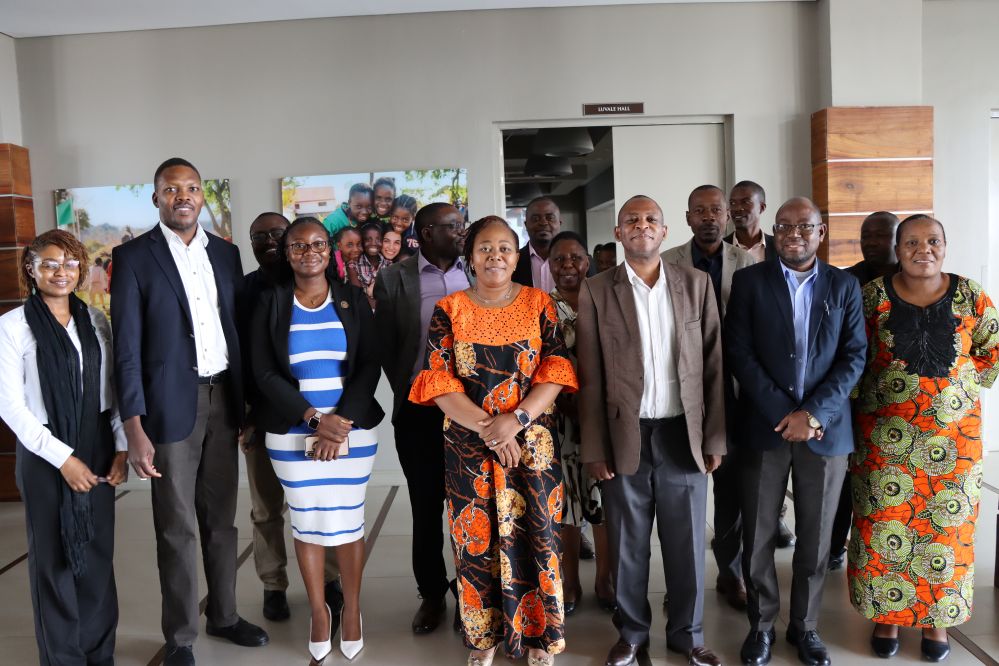
The Project Steering Committee (PSC) is chaired by the Permanent Secretary for Commerce and Industry, MCTI in charge of Investments and Industrialization. The PSC comprises of members from public and private institutions. The PIU serves as the Secretariat of the Project Steering Committee.
The PSC provides general oversight including approval of Annual Work Plans and Budgets (AWPBs) and ensures that an enabling environment policies, regulations and guidelines are in place to facilitate effective project implementation.
The PSC meets at least once per quarter particularly during the first two years of the project, but shall have a minimum of two meetings in a year as per Financing Agreement for the Project. The Steering Committee will develop its rules and guidelines to guide its operations including decision-making. Ten out of the fifteen members will form a quorum. A steering committee member may officially delegate a proxy/representative to represent his/her organization in instances of inability to attend a meeting. It is expected that this proxy/representative is the same person for each absence. PIU will submit the agenda of the PSC to DPI and the WB in parallel for review.
The Steering Committee shall be responsible, among other things, for the following functions:
a.) Overseeing overall project implementation;
b.) Provision of policy guidance to the project; and
c.)Ensuring inter-agency/Ministry coordination of the project.The Committee will also consider issues to do with broader E&S and fiduciary issues that are substantive during the course of the project if they arise. In such cases, other relevant government departments will be co - opted into the steering committee.